THE DSA MACHINE DESCENDS ON GOTHAM
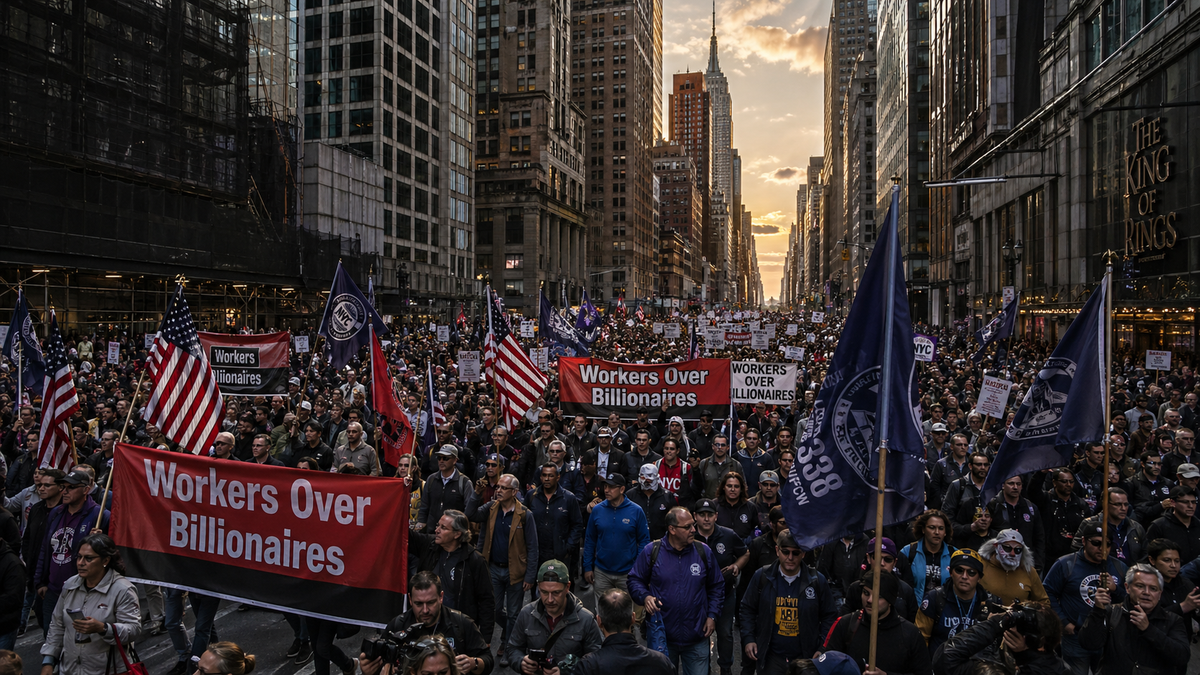
Tomorrow tens of thousands march through Lower Manhattan under the banner "Workers Over Billionaires." But this isn't a labor movement. It's a coordinated political operation — and New York is just the delivery mechanism.

What May Day 2026 is really about — and why you should pay attention
Tomorrow, tens of thousands of people will pour into the streets of Lower Manhattan. They'll carry signs, chant slogans, and march from Washington Square Park down Broadway to Foley Square. The press will be there in force. Local politicians will offer statements of solidarity. And by nightfall, the networks will run footage of a city rising up. That's the story you're supposed to see.
Here's the one you're not.
What's descending on New York Friday is not a labor movement. It isn't even, in any serious sense, a protest. It is a coordinated political operation — one of the most logistically sophisticated street-level mobilizations in recent American history — organized across nearly 500 groups, covering more than 750 events nationwide, designed to produce one thing above all else: political pressure on Democratic officials who might otherwise consider cooperating with the federal government on immigration enforcement. This is the machine at work. And the machine has been preparing for this day for months.
The organizing umbrella calls itself May Day Strong. Its explicit model is the 2006 Day Without Immigrants, the coordinated national walkout that brought more than a million people into the streets and fundamentally altered the trajectory of the immigration debate for years afterward. That's not a coincidence. That's a road map. The people running Friday's events understand exactly what they're trying to replicate — the visual scale, the media saturation, the sense of civic emergency — and they have the institutional infrastructure to pull it off.

In New York specifically, the day is choreographed with precision. At 2 p.m., organizers gather at Union Square under the banner "No School, No Work, No Shopping." By 3 p.m., a separate contingent fills Washington Square Park, calling on Governor Hochul to openly defy ICE. At 4 p.m., the AFL-CIO's New York Central Labor Council anchors the main rally, with UAW members stationed at the Garibaldi Statue. The march then steps off down Broadway, arriving at Foley Square — directly in the shadow of the federal courts and City Hall — by early evening. Simultaneously, events ripple through Brooklyn and the outer boroughs. No neighborhood is incidental. Every venue is selected for symbolic weight.
The unions are present throughout. The National Education Association has published a May Day organizing toolkit for teachers, characterizing it not as a rally but as "a strategy." That's the honest framing. This is strategy. The UAW's official mobilization language calls for workers to march "against fascism." Get Free NYC, one of the organizing anchors at Washington Square Park, has been explicit that any politician who cooperates with ICE will face political consequences — that "no politician can keep their job" if they side with federal immigration enforcement. That is not a protest demand. That is a threat, delivered in the grammar of a constituency that expects to be obeyed.
This is worth understanding clearly. The traditional labor movement — the one that actually built the May Day tradition, that sent 60,000 workers into the streets of Chicago in 1886 demanding an eight-hour workday — organized around concrete shop-floor grievances. Wages. Hours. Safety conditions. The power of that movement came from its specificity: workers in a particular industry, facing particular bosses, demanding particular changes. What has replaced it is something structurally different. The unions now provide the bodies and the institutional legitimacy. The immigration advocacy coalition provides the moral energy and the media narrative. And the progressive political apparatus provides the strategic coordination, the donor infrastructure, and the long-term electoral targeting. What you end up with is not a labor movement. It's a political party conducting an outdoor caucus.
NOW: Thousands marched through New York City among groups with communist flags, anti Trump signs, Luigi Mangione fans and Unions on annual Mayday pic.twitter.com/5L8YQ2fuO1
— Oliya Scootercaster 🛴 (@ScooterCasterNY) May 2, 2025
The slogan "Workers Over Billionaires" is smart messaging. It sounds like economic populism. It sounds like the kind of thing union members in swing states might actually respond to. But peel it back and the policy agenda underneath is not about wages or working conditions in any substantive sense. It is about immigration enforcement — specifically, about making it politically impossible for Democrats in blue cities to cooperate with the Trump administration's efforts to enforce existing law. The workers holding those signs are not primarily being organized around their wages. They're being organized around a political position on federal immigration policy, which is a very different thing, and one that serves a very different set of interests than those of the average union household.
None of this means the people marching tomorrow are bad people. Most of them are exactly what they appear to be: citizens who are angry, worried, and looking for somewhere to channel it. That is entirely legitimate. But the organizations directing that energy, the ones who decided on the routes and the timing and the messaging and the media strategy, have a different set of objectives than the people who show up with handmade signs. They always do.
Foley Square will be packed by 6 p.m. Broadway will be impassable through Lower Manhattan. The 1 and 2 trains will be running behind schedule. The television cameras will be there. And somewhere, in a communications office that doesn't photograph well, someone will be watching the footage and counting heads, and making calculations about which elected officials are sufficiently frightened and which ones still need more persuasion.
As the Left gears up for May Day, expect more trainings like this one from the Party for Socialism and Liberation.
— Stu Smith (@thestustustudio) April 18, 2026
Their message is plain: “There is nothing more powerful than the people shutting it down.”
For May 1, they are organizing around “no work, no school, no shopping,… pic.twitter.com/3e535MDRDH
That is what May Day 2026 is. Not a holiday. Not even really a protest. A demonstration of capability. A message sent from the machine to the people who are supposed to be afraid of it. Tomorrow, New York is the delivery mechanism.
 Gene Goodwin