THE VICTIMHOOD INVERSION: HOW NEW YORK'S MAYOR IS RUNNING POLITICAL COVER FOR THE WRONG CRISIS
The "Islamophobia" frame isn't a description. It's a deflection vector. It shifts the debate from ideology and institutional networks to identity. Mamdani knows the difference between Islam and Islamism. He chose to blur it anyway.

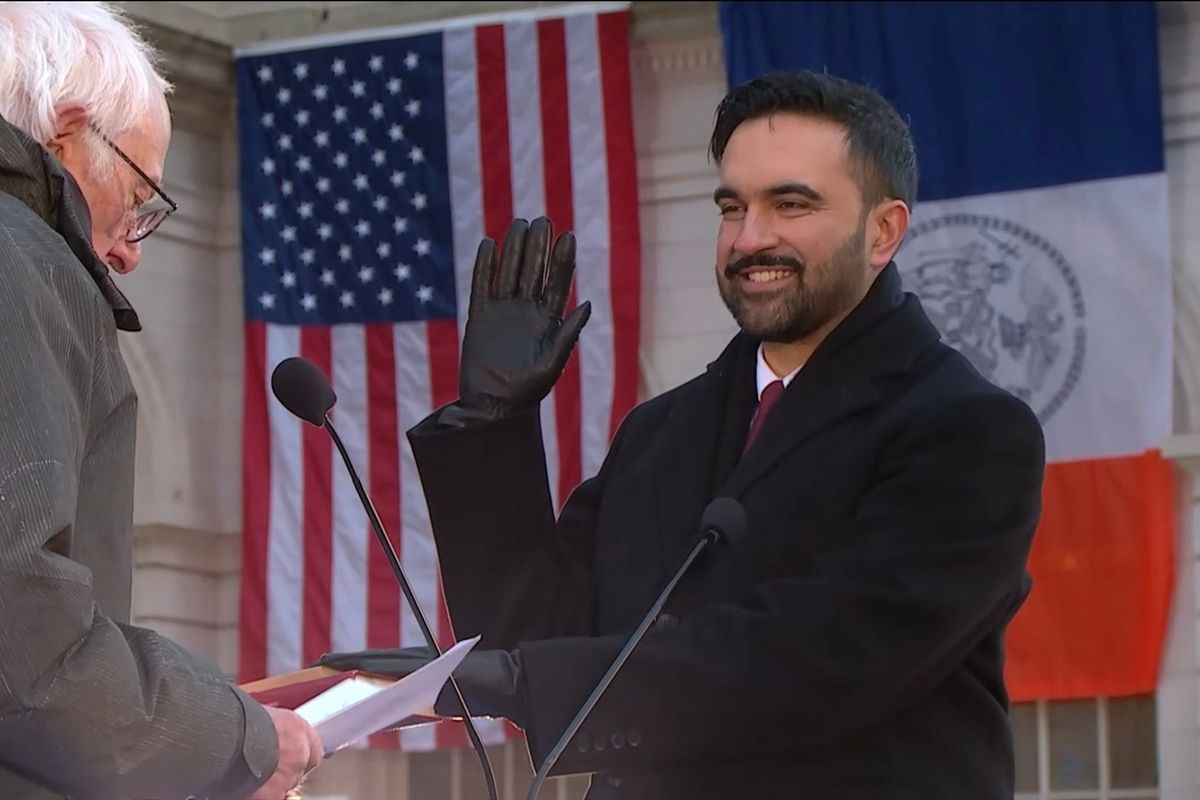
There is a technique, well-documented in the study of information warfare, called narrative displacement. You do not deny an uncomfortable reality. You replace it with a more convenient one. You flood the zone with a competing story until the original signal is buried under noise. What New York City Mayor Zohran Mamdani did in his recent interview was a case study in exactly this technique, deployed with precision at a moment when the data tells a very different story than the one he is selling.
TODAY 🚨 In Brooklyn, New York Muslims are praying in public in Prospect Park with
— Wall Street Apes (@WallStreetApes) March 20, 2026
Mayor Zohran Mamdani
This is the Islamic Takeover of America pic.twitter.com/Y4IlrIRiy5
Mamdani said anti-Muslim bigotry is "unabashed," "echoed from the highest offices in the country," and that Muslim identity has been made to feel "in tension with being a New Yorker." He called it "endemic to our politics." These are not casual observations. They are framing devices. And framing, in political strategy, is not description. It is an instruction. It tells the audience what to see and, more importantly, what not to see.
What the FBI Data Actually Shows
The FBI Hate Crime Statistics report is not a partisan document. It is compiled annually from law enforcement agencies across the country and published with no editorial agenda. The 2024 report, the most recent year on record, is unambiguous.
There were 1,938 anti-Jewish hate crime incidents in 2024. There were 228 anti-Muslim hate crime incidents. Jews represent approximately 2% of the U.S. population yet account for 69% of all religion-based hate crime victims. Anti-Jewish physical assaults rose 21% in a single year. By the FBI's own accounting, 2024 was the worst year for antisemitic hate crimes since the bureau began collecting this data in 1991. That translates to more than five anti-Jewish hate crimes every single day.
These numbers are not an anomaly of one bad year. They represent a structural pattern going back to at least 1996. In every single year of available FBI data, anti-Jewish hate crimes have outnumbered anti-Muslim hate crimes by ratios ranging from 2-to-1 to nearly 10-to-1. The consistency of this pattern across nearly three decades of data, spanning multiple administrations and wildly different geopolitical contexts, makes it one of the most stable findings in American civil rights statistics.
This is the city Mamdani governs. This is the data he chose not to mention.
The Strategic Logic of the Shield
To understand why Mamdani is making this argument now, you have to understand what the argument is designed to accomplish. It is not primarily a statement about hate crime statistics. It is a pre-emptive legal and rhetorical defense against a category of criticism that has become increasingly precise and increasingly difficult to deflect.
Just one week ago an ISIS terrorist tried to blow up anti-Mamdani protesters.
— The Persian Jewess (@persianjewess) March 18, 2026
Since then Mamdani has made it his mission to do everything he can to draw attention away from this attack.
pic.twitter.com/Otxbbo47m7
Republicans and national security analysts have spent the past two years building a specific case. The argument is not that Muslims as a community pose a threat. The argument is that a distinct political ideology, Islamism, has penetrated American municipal politics through figures with documented organizational ties, and that this ideology is strategically aligned with foreign actors currently engaged in armed conflict with a U.S. ally. That is a geopolitical argument. It is an institutional argument. It is an argument about power, alignment, and strategic interests.
Mamdani cries and plays the victim card, saying that the problem in New York is Islamophobia. Same buIIshit Sadiq Khan says in London. Same scheme. pic.twitter.com/zlUZN4fB7l
— RadioGenoa (@RadioGenoa) October 27, 2025
The "Islamophobia" frame is the most effective available counter to that argument because it operates on a different register entirely. It shifts the debate from ideology and institutional networks to identity and religious belonging. It forces critics to spend political capital defending themselves against charges of bigotry rather than pressing their original case. It is, in the vocabulary of information operations, a deflection vector. And it is specifically calibrated to a domestic American political environment where accusations of religious discrimination carry significant reputational weight.
Mamdani is not the first politician to deploy this frame, and he will not be the last. But he is deploying it as the sitting mayor of the largest city in the United States, which means the stakes of the deflection are correspondingly larger.
The Islamism Distinction He Is Burying
There are over one million Muslims living in New York City. The overwhelming majority are working Americans building ordinary lives, contributing to neighborhoods across all five boroughs, and bearing no relationship whatsoever to the political ideology being scrutinized. No serious analyst of this issue is conflating them with the ideological movement under examination. The distinction between Islam as a faith and Islamism as a political program is not subtle. It is the foundational distinction that makes serious analysis of the latter possible without doing injustice to the former.
Here's another example of Zohran Mamdani disgustingly attempting to make himself the victim of September 11th.
— MAZE (@mazemoore) October 25, 2025
Mamdani (was a privileged rich kid who went to elite private schools) regularly uses 9/11 to paint NYC as racist and islamophobic. pic.twitter.com/mFeD8HsD2V
Mamdani knows this distinction. He studied political science. He has spent years operating in the ecosystem of progressive politics where these terminological lines are drawn and redrawn constantly. His decision to blur them is not a failure of precision. It is a choice. The blur serves a purpose. When you make the criticism of a political ideology unspeakable by dressing it up as an attack on a religious community, you have effectively immunized that ideology from scrutiny. That is the strategic outcome Mamdani's framing produces, whether or not it is consciously intended.
Who Is Actually Being Erased
The question the mayor's interview demands is the one he did not answer: if we are talking about erasure, whose erasure are we actually documenting?
The Jewish community in New York City is navigating a security environment that has no contemporary parallel in American urban life. Synagogues require armed security details. Jewish schools operate under threat protocols. Community members have modified their public behavior, where they walk, what they wear, what they say aloud. The FBI data suggests this is not paranoia. It is a rational response to a documented, escalating, thirty-year pattern of targeted violence.
The mayor of New York City gave an interview expressing concern about the political climate for one religious community. He said nothing about the community that his own city's data, and the federal government's data, identifies as the primary target of religious hate violence in America. That silence is not neutral. In strategic terms, silence is always a choice. And choices, at the mayoral level, have consequences that extend beyond rhetoric into resource allocation, policing priorities, and the signal that civic leadership sends to a city watching carefully to see who its government is actually protecting.
Victimhood is a form of political capital. In American politics, it confers moral authority, generates coalition loyalty, and insulates the holder from certain categories of criticism. When that capital is claimed by misrepresenting who is actually being targeted, the real victims lose something concrete. Their crisis becomes less visible, less urgent, less politically actionable. That transfer of visibility is not a side effect of Mamdani's framing. In a city this politically sensitive, it is the point.
BREAKING: Who bankrolled @ZohranKMamdani's campaign and the DSA takeover of the Democrats? @lsarsour tells all.
— Canary Mission (@canarymission) November 3, 2025
Mamdani’s rise was NEVER grassroots, it was bought and paid for by @CAIRNational. pic.twitter.com/zJzmm697uv
The FBI data is public. The mayor's interview is public. Read both. Share this piece with anyone who governs, covers, or lives in New York City. If you believe civil rights reporting should follow the data wherever it leads, subscribe and forward. Accountability requires an audience.
Disclosures & Source Attribution
Primary Source: FBI Hate Crime Statistics, 2024 Annual Report (publicly available via fbi.gov). Note: All hate crime figures cited are drawn directly from FBI published data. Population percentage figures sourced from U.S. Census Bureau and Pew Research Center demographic estimates. Mayor Mamdani's quotes sourced from his public interview as referenced in source material. This analysis represents the author's independent interpretation of publicly available government data.