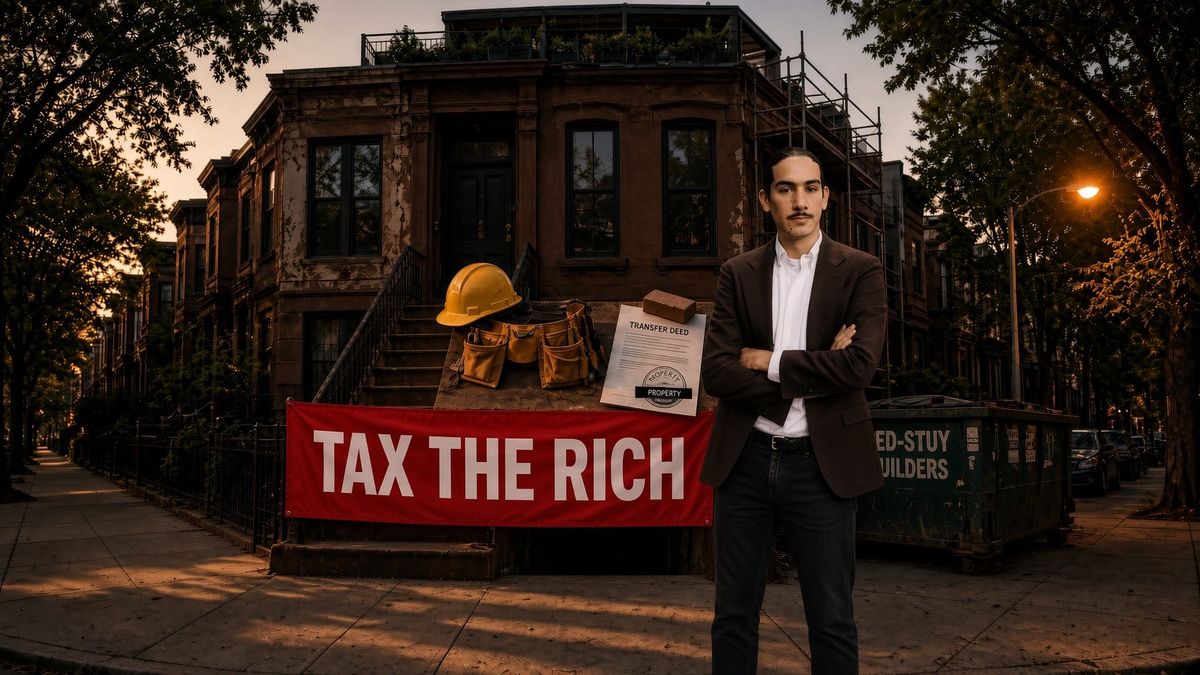
DSA's 'Tax the Rich' Chair Lives in a $1.5 Million Bed-Stuy paid by his parents
Property records and his father's own admission confirm NYC-DSA co-chair Gustavo Gordillo, a leading voice for "tax the rich," lives in a $1.5 million Bed-Stuy house his parents' LLC purchased and renovated.

🚨 “Democratic Socialism Is on the rise. 26% of New York City voters identify as Democratic Socialists.”
— Stu Smith (@thestustustudio) November 8, 2025
On Thursday’s NYC DSA call, co-chair Gustavo Gordillo laid out the movement’s surge in plain terms.
“A majority of Democratic Party registrants view socialism more favorably… pic.twitter.com/7FAZQSbVZc
Property records and his father's own admission confirm the NYC-DSA co-chair lives in a $1.45–1.5 million Bed-Stuy house purchased and renovated by his family's LLC.
Gustavo Gordillo tells Fox News that no one has a constitutional right to double-digit returns on an investment. His family's LLC has been getting one on him since 2016.
Gordillo, 38, co-chairs New York City's Democratic Socialists of America. He is a lead organizer on the Mamdani transition's Economic Development and Workforce Development Committee, a fixture of the "Tax the Rich" push, and a standing critic of landlords, private property, and investment income. He built his public identity on @unionGustavo, an electrician's account. He is not, by his own admission, working as an electrician. Union sources and the New York Post report he was terminated from his IBEW Local 3 apprenticeship for non-participation and never completed the journeyman process. He is a lapsed member of a trade he has not practiced.
The house is the record.
In 2019, Chucuito LLC, controlled by Gordillo's parents, purchased a nearly 2,000-square-foot two-story home in Bed-Stuy for just under $1 million. Plans filed in 2023 show a full facade overhaul, landscaping, an interior gut, a roof deck, and a front deck. Work was still visible on the second floor as of this week. Fair market value now sits around $1.45 to $1.5 million. Before Bed-Stuy, the same LLC covered a $2,600-a-month Lower East Side apartment for Gordillo from 2016 to 2019. His father, Gustavo E. Gordillo, confirmed the arrangement to the Post on the record: the LLC bought the home, and the family did the renovations. Both sons live there.
The parents are Peruvian immigrants who built Draftpros Inc., an engineering and consulting firm, from nothing. They now hold two additional properties in Florida: a five-thousand-square-foot house in Boca Raton listed at $3.1 million, and a second in Weston worth roughly $3 million. This is not a family scraping by. It is a family with a real estate portfolio and a son who wants the state to tax the returns that built it.
"My son and my other son both live there. The LLC purchased the home, and then we did the renovations." — Gustavo E. Gordillo, to the New York Post
The irony has a paper trail of its own. The Bed-Stuy property appeared on the city's list of potential targets under the pied-à-terre and luxury second-home tax, a policy push DSA-aligned officials backed. The house Gordillo's family used to subsidize him sat on the list of assets the movement he co-chairs wanted to hit.
DSA rhetoric has called for redistributing land from landowners to the landless. Gordillo lives rent-free, or close to it, in a house his parents' company owns outright. He is the landowner his own chapter's language describes, housed by exactly the private capital accumulation his politics exist to dismantle.
Canary Mission has documented Gordillo's anti-Israel record and BDS advocacy, part of a broader alignment with the harder edges of the NYC-DSA ecosystem, the same ecosystem that delivered Mamdani and now shapes city housing, tax, and justice policy from inside government.
Neighbors have noticed the gap between the persona and the arrangement. One put it plainly to the Post: it's a rich kid, someone who doesn't have to deal with the struggles the rest of the block deals with.
This is not an isolated case. It is the standing pattern of the affluent radical: inherit or occupy the fruits of private enterprise, then organize against the conditions that produced the comfort. Immigrant parents build a company. They buy real estate. They house their son. He leads the fight against returns on investment and private ownership, on television, under a union handle he no longer earns. The networks pushing housing justice and land redistribution keep finding new landlords to name. They have not yet found this one.