The Blast Radius Field Manual: How to Survive a Terror Attack in a City That Won't Help You
A bombing in Midtown. A coordinated subway attack. A truck in a crowd. When it happens, the physical danger will be immediate, the informational environment will be hostile, and the city's response will be shaped as much by ideology as by your safety. This is the guide for that moment.

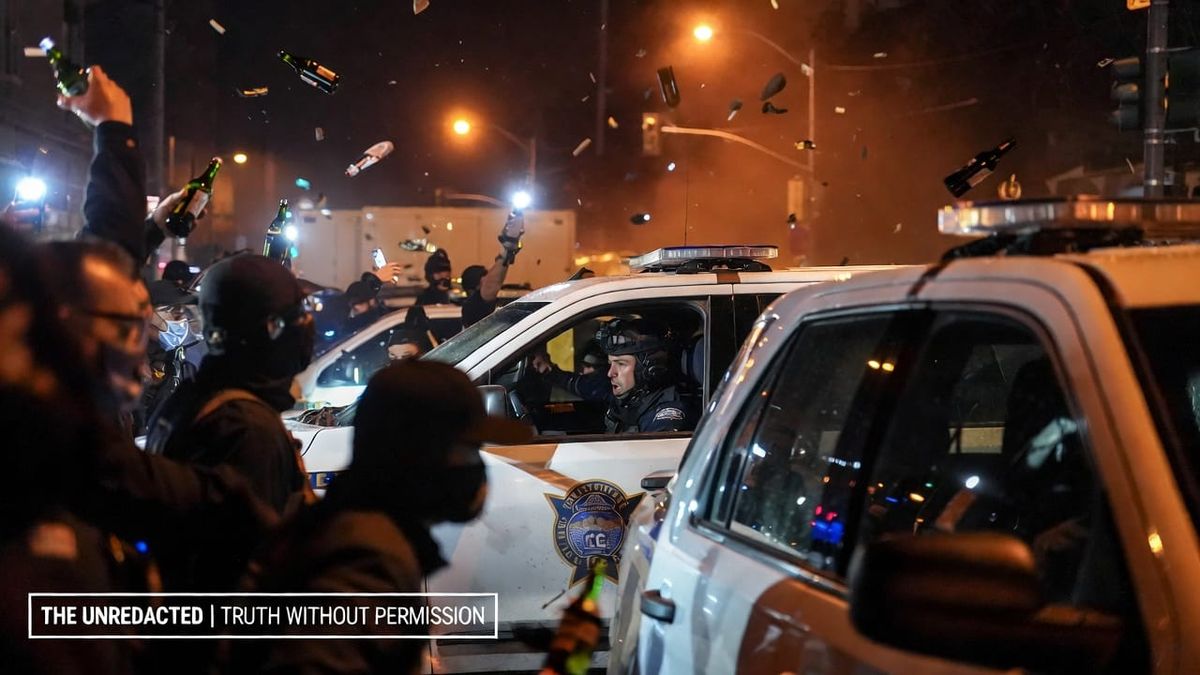
This is the companion piece to When the City Stops Protecting You: A New Yorker's Field Manual for the Mamdani Era. That guide covered riots, mobs, and organized street disorder. This one covers something worse.
Part One: The Premise
Do not assume that because you are a victim, the city will treat you like one.
After October 7, you watched an atrocity get reframed in real time. Massacres became "resistance." Hostages became "prisoner exchanges." NGOs and activist networks raced to adjudicate who qualified for moral standing, and the dead lost the argument in most major newsrooms before the blood dried.
We covered what that infrastructure looks like from the inside. The donor networks behind the bail funds, the coordinated street operations outside Delaney Hall, the foreign influence pipelines that fund the messaging machine. The apparatus is real, it is funded, and it is faster than first responders at shaping the story.
Now apply that to a bombing in Midtown. A coordinated subway attack. A truck in a crowd on the West Side Highway.
When it happens, assume three things simultaneously:
The physical danger will be immediate and local.
The informational environment will be chaotic, political, and hostile.
The city's response will be shaped as much by ideology and optics as by your safety.
Your job is not to fix any of that. Your job is to get yourself and your people out of the kill box and into a place where you can think.
Waiting continues outside Delaney Hall we Curfew passed. pic.twitter.com/JSxSC6hs5O
— Oliya Scootercaster 🛴 (@ScooterCasterNY) June 1, 2026
Part Two: Rule Zero — Treat This Like a Hurricane, Not a Movie
The way you survive is boring. Plans, drills, redundancies.
The people who die are often the ones improvising under stress. Wandering toward sirens. Refreshing social feeds. Waiting for someone to tell them what to do.
So you steal from hurricane doctrine: pre-set meeting points, pre-set routes, pre-packed bags, pre-agreed signals. When it happens, you execute. You do not debate.
The Mamdani administration has been explicit that the city's emergency posture will be filtered through the same politics that produced the stand-down at Delaney Hall. In a terror event, that means you cannot assume coordinated guidance will come fast, or that it will come without a political edit. You need your own protocol before you need the city's.
NOW: Anti-ICE protesters using umbrellas as ICE Agents spray pepper spray and shove people back as crowds continue blocking second entrance at Delaney Hall ICE detention facility in NJ pic.twitter.com/PWsZc0xLVX
— Oliya Scootercaster 🛴 (@ScooterCasterNY) May 29, 2026
Part Three: The Plan
Step 1 — Map Your Triangle
Before anything happens, you need a mental map of the three places you spend most of your time when things go bad: home, work, and your main transit nodes.
This week, sketch three small maps on paper. Your building and block. Your workplace and surrounding streets. Your main subway hubs. On each map, circle three ways out on foot. Not trains. Not rideshares. Feet.
Walk each route once in real life. Note the chokepoints — narrow sidewalks, scaffolding, fenced lots. Note the open spaces — parks, schoolyards — where you can regroup. Note which areas have cameras, lights, and foot traffic, and which are dead zones at 10 p.m.
You are building muscle memory. The time to build it is not during the event.
Step 2 — Designate Your Two Corners and One Far Point
When systems fail, your people will look for you. The single most important thing you can do is tell them where you will be if the phones die.
Corner 1 — Near home. Pick a specific, non-obvious landmark within a 10-minute walk. Not the bodega everyone knows. A particular church step, a bench in a small park, a quiet side street corner. Everyone in your household memorizes it.
Corner 2 — Near work or school. Same idea, but near your primary daytime location. If something happens while you are at the office or your child is at school, this is the rally point once you are clear of the building.
Far Point — Outside your neighborhood or borough. A friend's apartment in a different part of the city. Harlem if you are in Brooklyn. Astoria if you are in Midtown. This is the destination if your neighborhood is cordoned, chemically compromised, or politically on fire.
Write these three locations on a physical card. Put it in your wallet and in the wallets of everyone you are responsible for. Paper does not need a cell signal.
BREAKING: Barricades clashes continue between anti Israel protesters and the NYPD during the march from Park East Synagogue "Land Sale" event. pic.twitter.com/xJZ4ZPWwjh
— Oliya Scootercaster 🛴 (@ScooterCasterNY) May 6, 2026
Step 3 — Pick an Out-of-Area Human
In disasters, local cell networks jam. Sometimes one thing still works: a call or text to someone outside the blast zone.
Pick one person who is not in New York. Someone in New Jersey, upstate, another state. Save them in your phone as "ICE — Anna (Upstate)." Tell everyone in your household: if something big happens and we cannot reach each other, we all contact Anna. She becomes the switchboard.
This works because it routes your coordination around the congested local network. It is standard emergency doctrine. Most people do not do it. Do it this week.
Step 4 — Build the Go Bag That Assumes the City Is Closed
NYC already tells you to have a Go Bag. You pack it with the assumption that the subway is down, ATMs are offline, and you may need to move through heavily policed or hostile space for 48 to 72 hours.
For each adult: 1 to 2 liters of water. Four to six high-calorie bars. Photocopies of ID, insurance, and prescriptions in a zip bag. Small bills only — $1s, $5s, $10s, because card readers fail first. A battery pack and cable. Basic trauma supplies: gauze, pressure bandage, tourniquet, 72-hour supply of any essential medications. An N95 mask. A compact flashlight and a whistle. A bandana.
For the apartment: one gallon of water per person per day for at least seven days. Shelf-stable food you actually eat. A manual can opener. Prescription buffer of 30 days if your doctor provides it.
You are not prepping for collapse. You are buying yourself 72 hours where you are not forced into bad decisions because you are thirsty, out of medication, and broke.
BELGIUM: Brussels currently looks like a war zone.
— Dr. Maalouf (@realMaalouf) June 4, 2026
This is the capital of the European Union. 88% of the population under the age of 20 is of foreign origin, and over half is Muslim.
What did Europe do to itself? pic.twitter.com/Sd9vSxybdy
Step 5 — Script the First 10 Minutes
The first 10 minutes are where people get killed. Rushing toward the exits, everyone else is using them. Pulling out phones instead of moving. Freezing.
You do not rise to the occasion. You fall to your knees. So write simple scripts now.
If it happens in the subway: Drop below sightlines if there is gunfire. Behind pillars, vending machines, anything that stops shrapnel. Move only when you have a clear path. Ignore your train. You are evacuating the station, not catching a connection. Follow the staff if they are giving coherent directions. If not, pick the exit that takes you up and out, even if it is not your usual one. Once you are on the street and one full block away, check your phone for two things only: NYC Emergency Management alerts, and a pre-agreed text to your out-of-area contact.
If it happens near your building: Grab your Go Bag and hard copies of documents. No laptops. No valuables. Use stairs, not elevators. Move to Corner 1 if the street is clear. If it is not, put solid structures between you and the hazard and adjust.
If it happens at work: Follow the building's evacuation plan through the first phase. Once you are out and away from any secondary-target zone — lobbies, plazas, large outdoor crowds — pivot to your own plan. Nearest safe route to Corner 2, or directly to Far Point, depending on what was hit.
Write these three scripts on one page. Tape it inside your front door. Review it every few months.
In Parc des Princes area of Paris, rioters of North African ancestry are seen firing fireworks at Police officers patrolling the streets of Paris
— D. Scott @eclipsethis2003 (@eclipsethis2003) May 31, 2026
Police officers were targeted by numerous shots of fireworks and projectiles. pic.twitter.com/M4FNCqNz0G
Step 6 — Decide Now When You Shelter Instead of Run
A lot of emergency doctrine defaults to "evacuate." In a terror scenario with multiple attackers or an unclear threat, running gets you killed.
Identify a shelter room now. An interior room with no windows, or minimal windows: bathroom, hallway, interior bedroom. A door that locks. Space for your household to sit for several hours. Your Go Bag and extra water are a already staged there.
Shelter conditions: You hear gunfire or explosions, but cannot identify the direction. You see a crowd stampeding outside without a clear reason. Official channels confirm a chemical release or an unknown device.
In that case: lock the door, move heavy furniture against it if you can. Turn phone sounds off, keep vibration on. Check alerts every 10 to 15 minutes, not continuously. Send a pre-agreed code to your out-of-area contact.
NOW: ICE Agents beat a Protester with batons against a truck in the street outside of Delaney Hall another arrest made. pic.twitter.com/FEnGus5MJW
— Oliya Scootercaster 🛴 (@ScooterCasterNY) May 28, 2026
Step 7 — Move Through a Locked-Down City
After the initial attack, the city's response hardens fast. Roadblocks, frozen bridges, helicopters, and possibly National Guard. You are now moving through someone else's operation.
The rules: Do not argue with barricades. Find another path one block over. Keep your hands visible near any checkpoint. Your script if questioned is short: where you live, where you are going, here is my ID. Nothing more. Avoid joining crowds. Crowds are targets, and in this city under this administration, they are also convenient pretexts for kettling people the response finds inconvenient.
You are not trying to break through. You are trying to flow around.
Step 8 — Assume the Narrative Turns on Contact
While you are doing all of this, the media machine and the activist infrastructure will be moving at the same speed. We have documented how that machine operates. The CODEPINK and Palestine Action networks have pre-built response templates. Foreign influence operations will have talking points live before the smoke clears. Some of that will shape who gets sympathy, who gets blamed, and which communities get treated as suspects.
Operationally, this means: if your visible identity maps onto any group likely to be scapegoated, think in advance about low-profile clothing, routes that avoid known flashpoints, and safe locations that are actually safe for your family.
Prioritize instruction over interpretation in your information diet for the first 24 hours. Emergency alerts, transit updates, shelter orders. The analysis can wait. Do not let anonymous accounts and "second device" rumors move your feet. The day of, you are not a journalist. You are just trying not to become content.
Step 9 — Practice It
Once a quarter, walk your escape routes. Time yourself from your front door to Corner 1, Corner 2, and Far Point. Run a 15-minute communications blackout drill: phones down, where does everyone go. Check Go Bag expiration dates and water supply twice a year.
If it feels excessive, you are doing it right. You are converting what would be chaos into mild inconvenience.
BREAKING: Barricades clashes continue between anti Israel protesters and the NYPD during the march from Park East Synagogue "Land Sale" event. pic.twitter.com/xJZ4ZPWwjh
— Oliya Scootercaster 🛴 (@ScooterCasterNY) May 6, 2026
Part Four: The One-Page Field Card
Condense this into one sheet. Tape it inside your front door and save a photo of it on your phone.
Three locations: Corner 1, Corner 2, Far Point.
Out-of-area contact: name, number, city.
Simple codes: A = safe, B = injured, C = sheltering, D = evacuating.
Three scripts: subway attack, near home, at work.
NYC's own preparedness guides run long. The people who get out usually have something short, practiced, and on paper.
Final Note
You did not choose this city to become a battlefield. Most of you paid taxes, raised children, built lives, and asked for nothing except basic order in return.
You may not get it. We have spent months documenting why: the funded infrastructure behind the disorder, the political machinery that decided the lawbreaker is the constituent, the foreign actors who benefit from the chaos.
Knowing the architecture does not make you safe. Preparation does.
Build the kit. Walk the routes. Write the card. Talk to your neighbors before you need them.
The city is still yours. Act like it.
The Unredacted publishes intelligence that the institutional press won't. If this guide was useful, forward it to someone who needs it and consider becoming a subscriber.