The Ghetto Fighters and the City That Forgot Them
THIS MORNNING: ISRAEL STANDS STILL FOR HOLOCAUST REMEMBRANCE Across Israel, life came to a complete halt as a two-minute siren sounded nationwide.

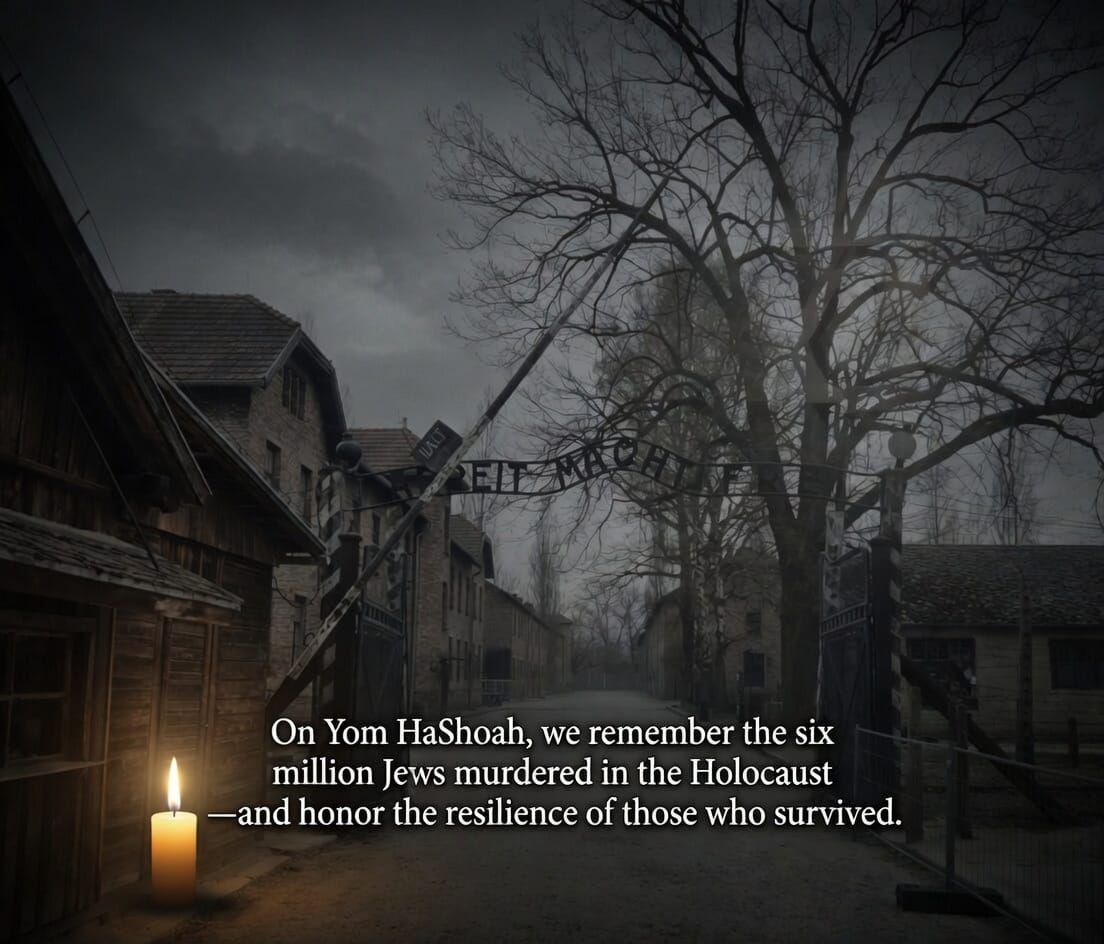
Every spring, Israel stops. Not metaphorically, not in the polite sense of a nation pausing to reflect over its morning coffee. It stops completely. Sirens scream for two minutes across the length and breadth of the country. Drivers pull their cars to the shoulder of the road and stand beside them in silence. Children who were fidgeting in their classrooms a moment earlier go still. The air itself seems to hold its breath. This is Yom HaShoah, Holocaust Remembrance Day. Six million names pressed into two minutes of noise and silence. The date is not accidental. The twenty-seventh of Nisan falls during the period of the Warsaw Ghetto Uprising of 1943. The choice tells you everything about how a people chooses to carry its grief. Not only as victims. Also as fighters.
🚨 THIS MORNNING: ISRAEL STANDS STILL FOR HOLOCAUST REMEMBRANCE
— Mossad Commentary (@MOSSADil) April 14, 2026
Across Israel, life came to a complete halt as a two-minute siren sounded nationwide. pic.twitter.com/h5kw18ZYp5
That distinction matters enormously and it is being forgotten with startling speed.
By the spring of 1943 the Warsaw Ghetto had been reduced from nearly half a million souls to around fifty thousand. The rest had been taken to Treblinka and murdered. Those who remained knew precisely what was coming. When the Germans moved in to finish the job, the Jews fought back. They had almost nothing. Smuggled pistols. Revolvers. Homemade Molotov cocktails. A few hundred young men and women against one of the most ruthless military machines the world had ever produced. And yet they held for nearly four weeks. They turned apartment buildings into fortresses. They made the Germans pay for every street and every staircase. The Nazis had expected a swift and clean operation.
The train to Auschwitz in 1942.
— Eli Afriat 🇮🇱 (@EliAfriatISR) April 13, 2026
The color footage reveals a stark contrast between the innocence of those aboard and the horrific fate that awaited them.
Dressed in their best clothes, they moved toward their final destination, the gas chambers.
Never again.💔 pic.twitter.com/19jnSTi1bn
They brought in artillery. They brought in reinforcements. The battle cost them dozens of dead and many more wounded. Some Jews escaped through the sewers. Others found hiding places that bought them weeks or months. The uprising saved lives, delayed the machinery, and above all preserved something that bureaucracies of extermination most want to destroy: the knowledge that resistance is possible.
The lesson the Warsaw fighters bequeathed to history is not simply one of courage, though their courage was extraordinary. It is that a people who refuses to accept the role assigned to it by its enemies retains its dignity regardless of the outcome. They knew they could not defeat the Wehrmacht. They fought anyway. This distinction between defiance and victory is one that comfortable Western liberals have never quite understood, and it is one that Jews living in the West today are being forced to learn all over again.
Eternal glory to the Jewish partisans and the Heroes of the Warsaw Ghetto Uprising. pic.twitter.com/TWnS3lGEkT
— Blake Flayton (@blakeflayton) April 14, 2026
The massacre of October 7th, 2023 was the largest single-day killing of Jews since the Holocaust ended. Twelve hundred people murdered in their homes and at a music festival. Babies burned. Women raped. Hostages dragged into tunnels. The details were so specific and so grotesque that they should have placed the event beyond politics for at least a decent interval. They did not. Next day, crowds in Western cities were celebrating. In London, in Berlin, in New York, protesters took to the streets with a speed and enthusiasm that contrasted sharply with their silence during the slaughter itself. On American university campuses, Jewish students found themselves harassed and isolated while faculty members competed to offer the most sophisticated justifications for barbarism. The blood libels returned. They simply wore better-tailored clothes.
New York is where this rupture has become most nakedly visible. The city contains the largest Jewish community outside Israel. It was rebuilt in significant part by Holocaust survivors and their children, people who came to America carrying almost nothing except the memory of what Europe had done to them and the determination to build something better. For decades, the city worked. Jews contributed to it enormously and felt, reasonably enough, that it was home. That feeling is now under sustained assault. Hate crimes against Jews account for more than half of all confirmed hate crimes in New York City, despite Jews comprising roughly ten percent of the population. In the opening months of 2026 the numbers remained alarmingly high. Swastikas appear on playgrounds. Rabbis are assaulted on streets in broad daylight. Jewish students describe their schools as places of anxiety rather than learning. These are not abstractions. This is the daily texture of Jewish life in the greatest city in the world.
Today is Holocaust Remembrance Day.
— Shirion Collective (@ShirionOrg) April 13, 2026
We Must Never Forget.
Please watch at least the first two minutes of this documentary.
Eisenhower knew one day people would say the Holocaust never happened.
Just like they're doing today.
So this is what he did in response. pic.twitter.com/LSY5BH6VgP
For Mayor Zohran Mamdani among his first official acts after taking office was the revocation of executive orders his predecessor had put in place specifically to address this climate. One order had adopted the International Holocaust Remembrance Alliance definition of antisemitism, the most careful and widely accepted definition available. The other had prohibited city agencies and employees from participating in the Boycott, Divestment and Sanctions campaign against Israel. Both were swept away. The Israeli government responded immediately and bluntly, describing the decision as pouring antisemitic gasoline on an open fire.
In 1944 they stood in silence in the ruins of the Kovno Ghetto waiting for the end with nothing but a prayer whispered under their breath.
— AMIRAN 🇮🇱 (@Amiran_Zizovi) April 14, 2026
They were defenseless and alone. October 7th reminded us that the world has not changed but we have. We will never stand in those lines… pic.twitter.com/Moa3gSyXk6
The UJA Federation, the New York Board of Rabbis, and numerous other Jewish organizations expressed alarm. They were right to do so. When elected leaders in the capital of diaspora Jewish life dismantle the tools built to identify and combat Jew-hatred, they are not making a bureaucratic adjustment. They are sending a signal. The signal reaches everyone who was already inclined to believe that the Jews have it coming.
The people most appalled by this pattern are often accused of conflating criticism of Israeli policy with antisemitism. The accusation is itself a form of gaslighting. Nobody with serious intentions claims that Israeli government decisions are beyond scrutiny. But there is a category of people who are not interested in Israeli policy at all. They are interested in whether Jews should exist as a people with the same rights as other peoples. They chant for the elimination of a state containing nine million people. They harass Jewish students who have no connection to the Israeli government and who cannot reasonably be held responsible for its decisions any more than British Muslims can be held responsible for decisions made in Riyadh. The distinction between these two things is not subtle. It requires only honesty to make.
U.S. soldiers look at bodies stuffed into an oven in a crematorium in April of 1945.
— AP (@Average_NY_Guy) April 14, 2026
Never forget🕯️ pic.twitter.com/Qwnydkr53r
That honesty has become scarce. Universities that once existed to produce clear-eyed thinkers now host rallies celebrating groups that would slaughter their own students if given the opportunity. Media organizations that take pride in precision consistently understate the scale of antisemitic violence while treating every Israeli military action as a unique moral emergency. Politicians in cities with large Muslim populations have performed calculations and concluded that defending Jews costs votes they cannot afford. This is not a conspiracy. It is something more banal and more depressing: ordinary moral cowardice aggregated across institutions until it becomes policy.
We remember. pic.twitter.com/ykqG0Tj68k
— נועה מגיד | Noa magid (@NoaMagid) April 14, 2026
As the sirens sound this Yom HaShoah, the lesson of the Warsaw Ghetto is not simply historical. It is operational. The fighters of 1943 could not save everyone. They could not even save themselves. What they preserved was the principle that Jews do not go quietly, that they are not passive subjects of whatever history decides to do with them. That principle is now being tested again, not in a ghetto ringed by soldiers but in council chambers and lecture halls and newspaper offices.
The bravery required today does not demand a weapon. It demands the willingness to say clearly what is happening, to name it without euphemism, to refuse the social costs of honesty when fashionable opinion has decided that Jewish discomfort is an acceptable price for political convenience. It demands insisting that the Holocaust was a specific crime against a specific people and that the machinery which produced it is recognizable in its early stages if one is willing to look.
The ghetto fighters looked. They knew what they were facing and they fought anyway. We owe them at minimum the honesty to see what is in front of us, and the courage to say so.
A pile of human bones and skulls at Majdanek concentration camp near Lublin, Poland, in 1944.
— Eyal Yakoby (@EYakoby) April 13, 2026
Never forget. pic.twitter.com/mgrCK7OeNB